

Cyrus Carmack-Belton (2009–2023)
There is something deeply unsettling about how much loss this moment carries.
A child is gone.
A family will grieve that loss for the rest of their lives.
And another life will be marked by what happened forever.
There are no clean edges to this.
No resolution that makes it feel whole.
Just a sense that it did not have to be this way.
Rest in peace, Cyrus.
The Spark
Watching events unfold from the UK gives me a certain distance — and with that distance comes hopefully a degree of objectivity.
The boycott of Asian businesses by Black Americans did not emerge in isolation. It was triggered by the acquittal of Chikei Rick Chow, who was found not guilty of murdering 14-year-old Cyrus Carmack-Belton.
To say this caused outrage would be an understatement. There have been protests, and a civil lawsuit is now being pursued.
Please click on the following link for more context:
Black Americans call for boycotts after Rick Chow verdict
Then something else happened.
An Asian man uploaded a video daring Black Americans to boycott Asian businesses — suggesting they would not survive without them. Check the video below.
That video didn’t just offend. It provoked. And the response was immediate — and loud.
And it raises a wider question that sits behind all of this:
“What does real economic power actually look like?“
As I watched these events unfold, I found myself asking a different question. If President Captain Ibrahim Traoré were looking at this dispute through the lens of economic sovereignty and self-determination, what lessons might he draw from it?
Before answering that question, it’s worth understanding why this moment has resonated so deeply—and why the conversation has become about far more than a single court verdict.
The response — in their own words
A lot of the reaction has been captured online.
As Reese Waters pointed out in his video inflammatory and insensitive comments by Asian
man including daring Black people to boycott Asian business were like a red rag to a bull. Black
Americans have a long, documented history of organized protest and economic resistance.
This is not new behavior.
If you’d like to understand the range of reactions for yourself, the following videos provide useful context:
- Reese Waters — Asian Man Dares Black People to Boycott & Gets Dragged Offline
- Black Discoveries — They Thought the Boycott Was a Joke Until the Shutdown Hit
My mixed experiences with the Asian community
Before going any further, I want to make one thing very clear.
My own experiences with Asian people have never been one-dimensional.
When I lived in Nigeria, many of my teachers were Asian, and they were deeply respected and genuinely loved.
I still remember:
- Mr Lazarus, our Biology teacher.
- Mr and Mrs Mani, who taught Mathematics and, if memory serves me correctly, Chemistry.
- Mrs Akhtar, our Islamic Religious Knowledge teacher, who cared for us like an aunt as much as a teacher.
- Mrs Kim Osime, our school nurse, whose kindness became legendary among the students.
- Dr Gupta and his wife at the University of Benin campus, who would regularly share fresh produce from their garden.
These were positive, formative experiences that shaped my view of people long before race became a topic of public debate.
When I later returned to the UK, those positive experiences continued.
I will never forget the Asian GP who calmly reassured me when I feared something was seriously wrong with my health. It turned out to be stress.
Nor will I forget another GP who patiently helped me through digestive problems with professionalism, kindness and compassion.
And yet…
I have also experienced moments that I can only describe as racism.
- Being treated differently in shops.
- Receiving poor service in nail salons.
- Being watched—or followed—while simply browsing.
One moment stands out. I was in a fish and chip shop in Thamesmead. Queued like everyone else. Ordered like everyone else. When my turn came, I was given my food — but no bag. I had to ask. It was a small thing. But it wasn’t. I never went back.
And yet —
Contrast that with my acupuncture clinic today: Professional. Kind. Respectful.
The difference is night and day.
There are also shops I no longer go to because I was made to feel like a thief.
A member of my own family also experienced deep heartache after their relationship was rejected by an Asian family—even after converting to Islam.
So, when I speak about this issue, I do so from a place of mixed experiences.
And perhaps that’s precisely the point.
What people are seeing — and reacting to
There is a lot of content online right now — from both Black and Asian creators — addressing anti-Black racism, accountability, and tension. Some are worth watching.
The video by Klaize is comprehensive. It acknowledges the harm that has been done to the Black community by issues such as the Natasha doll scandal in China and the work of the Chinese government to counter Anti-Black racism in China and generally appeals to both communities to refrain from dealing with racism by inflicting more racism.
By the same token there are other videos like the following YouTube short which caught my attention because of a list that was posted to the comments section with incidents involving violence against Asian people being shared as proof of hypocrisy by Black People. Check out the highlighted comments by @Thoughts-nd in the video below sharing a list of Black people who have committed crimes against Asians.
For those who couldn’t see the comment on the comment section, I have highlighted it in the image below.
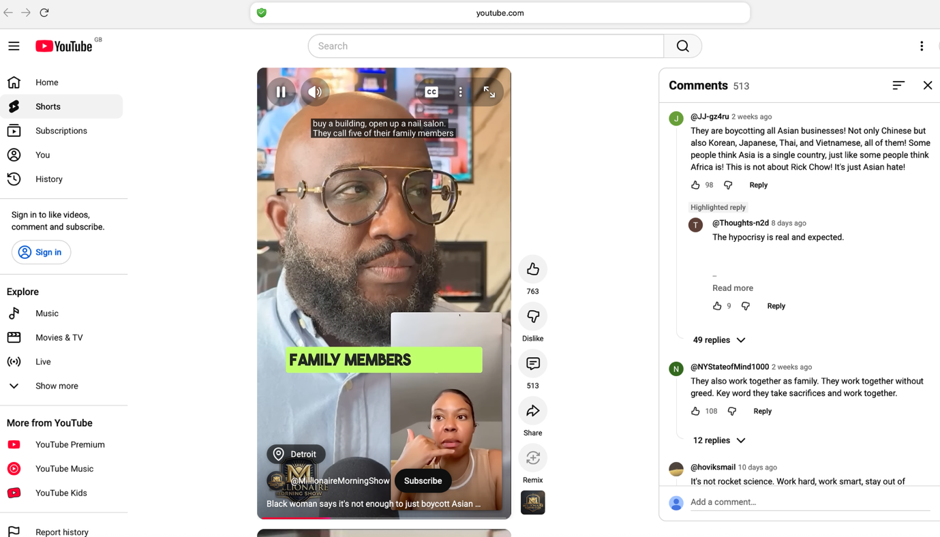
Screenshot of the comment from the user @Thoughts-nd, listing incidents involving violence against Asian people.
On face value the list looks persuasive but on close examination it is a mixture of proven hate crimes, general violence and opportunistic crimes. Where hate crimes have been proven, the courts have imposed substantial prison sentences. Any suggestion that these Black perpetuators got away with crime does not hold up legally.
But here’s the key point:
People/Asians do not experience these cases as separate legal categories; they just experience them as a pattern. This pattern then drives perception which then drives behavior. I personally do not think that Black people go out of their way to target Asians, but I can believe that a Black criminal might mug an Asian carrying a nice handbag or steal their mobile phone just as they would commit a crime against anyone from any other race including their own.
While violence and hatred towards members of the Asian community is to be condemned, could it be that the hate crime is driven by big trends such as the Natasha doll phenomenon and poor treatment of black people by Asians?
The Natasha Doll controversy
This moment/boycott is not happening in isolation.
The Natasha doll controversy — criticized for dehumanizing portrayals of Black people — has added to the broader emotional climate.
Trends like the Natasha doll controversy give the impression that some Asian people view Black people unfavorably. Does that lead some Black criminals to react to perceived unfavorable treatment by making racially motivated attacks on Asians? Even if the answer to this question is yes, it then also begs the question, – what came first, the chicken or the egg?
That said, it must be pointed out that going an eye for an eye will potentially leave both communities blind.
Moments like this do not just shape perception.
They influence behavior.
And behavior — over time — shapes economic choices.
Key sources:
- Natasha dolls: Hong Kong advocates decry ‘dehumanising’ Black baby ‘stress relief’ toy trending in China
- Natasha dolls: Why these dark-skinned baby toys are causing uproar over racism and violence
- ‘Absolutely Diabolical’: All about China’s Natasha Doll that has triggered global backlash
The context people ignore
There is also a structural economic dimension that often goes unspoken. Economic patterns show that a significant proportion of spending in many Black communities quickly leaves those communities — often because local businesses are not locally owned.
This means that even where there is strong economic activity, the long-term accumulation of wealth happens elsewhere. And that is the real issue. Because ownership — not just spending — determines where power ultimately sits.
The idea that Black communities are criminal and lazy ignores history. After slavery, Black Americans were structurally excluded from access to credit, land ownership and mainstream economic participation.
This is a massive topic for a future blog post, but African Americans, contrary to the impression of the man who made the inflammatory video, are hard working and ambitious. Unfortunately they have faced systemic discrimination denying them the fruits of the labor and generational wealth.
Again, this is a massive topic covering unfair remonstration following fighting in US wars, redlining, Jim Crow – the list goes on. We touched the tip of the iceberg while in the advanced Black History studies course the link of which is below. I have also left some links about the Tulsa Massacre and the destruction of Black wall street.
Black people have had to fight tooth and nail for every crumb, and their fights have lifted all other communities not only in the US but across the globe. African Americans are owed a debt of gratitude for their contribution to civil liberties and human rights, but what they often get is abuse and discrimination.
If you’d like to explore this history further, the following resources provide an excellent starting point:
The destruction of Tulsa’s prosperous Greenwood District—often referred to as Black Wall Street—remains one of the clearest examples of how Black economic success has historically been dismantled rather than encouraged.
For those unfamiliar with that history, CBS News’ documentary “Tulsa 1921: An American Tragedy“ offers a powerful overview.
Another compelling watch is the video below, Lush Presents: Greenwood Is Still Burning, which follows the ongoing legal fight to secure justice for the descendants of those affected.
Same system — Different roles
Asians are also victims of discrimination in America. Asian Americans are also sometimes held up as model minorities, but this is potentially as damaging as being the golden child in a family with a narcissistic parent. While being the golden child might seem better than being the scapegoat as Black people are often cast, – at the end of the day both children are damaged by narcissistic abuse.
In a narcistic home, one child is scrutinised and another one is positioned more favorably.
Different roles. Same narcissism in the home. Same system. Different roles. One is positioned more favorably within the system but neither of them are secure nor truly sovereign.
It is also important to understand how these dynamics developed.
Many Asian business owners did not arrive in these communities by accident. Immigration patterns, access to capital networks, and structural positioning within the wider system have shaped where and how businesses are established.
At the same time, Asian communities themselves have experienced discrimination, exclusion, and pressure within that same system.
This does not erase harm where it occurs.
But it does explain why these interactions are not happening between completely separate worlds — but within a shared structure.
Economic withdrawal is behaviour
When people feel disrespected, excluded, and undervalued — they withdraw.
That’s not new.
It’s human.
Boycotts are not ideological. They are behavioral.
In this moment, many Black women in particular, are expressing something very clear:
They are tired of being treated badly in certain environments, and they are choosing to respond in the one way they can control — where they spend their money.
That is not unreasonable.
But there is another truth that must sit alongside it:
Asian communities are also affected by the same wider systems of discrimination that shape all our experiences.
Both things can be true at the same time.
It is also important to acknowledge something else:
Boycotts have worked before. The Montgomery Bus Boycott demonstrated that sustained economic pressure can force systemic change. It was disciplined, strategic, and highly organized. So the question is not whether boycotts work. The question is: what conditions make them effective? Because not every boycott operates in the same context.

A photograph of Rosa Parks sitting toward the front of a newly integrated bus, the day the public transportation system in Montgomery was legally desegregated.
So what actually works?
For Black communities
Economic withdrawal is understandable.
But on its own, it cannot be the strategy.
Because withdrawal reduces engagement — but it does not build power.
The stronger strategy is:
BUILD
- build businesses
- build networks
- build economic ecosystems
Not as a reaction. As an intention.
In practical terms, this can start small.
It could be as simple as:
- choosing one category of spending — for example beauty, food, or services — and intentionally supporting a Black-owned business within that space
- pooling resources within trusted networks to support new businesses
None of this is perfect at the start. But that is how ecosystems are built — gradually, not instantly.
For Asian communities
Perceived stability is not the same as actual security.
If a position depends on:
- comparison
- external validation
then it is not fixed.
It can shift.
Because it was never entirely yours.
What would President Captain Ibrahim Traoré do?
This is where the conversation shifts.
Because the real question isn’t simply whether to boycott.
It’s:
“What does real economic power actually look like?“

Retaining value
If Black communities — not just in the United States, but globally — begin to intentionally
build:
- businesses
- networks
- economic ecosystems
then something changes.
Not overnight.
But structurally.
It requires patience.
It requires discipline.
And it requires something else that is often overlooked:
- treating each other well
- delivering good service
- building trust
- not exploiting one another
Because internal strength depends on internal integrity.
Now imagine scaling that across 50+ million African Americans, and then outward into the wider African diaspora and back to the continent.
That is not a small shift. That is economic force.
We already know this approach works.
Because it is being applied — in real time — in Burkina Faso and across the Sahel.
The direction is clear:
retain more of your resources and value within your own systems
Building local industry
The same principle applies beyond resources.
Instead of:
- exporting raw materials
- importing finished goods
the focus shifts to:
- processing locally
- creating jobs
- reducing dependency
Tomato processing initiative in Burkina Faso
Building regional strength
And it doesn’t stop at national borders.
The aim is coordination across:
- trade
- energy
- agriculture
- industrial development
Because scale matters as we have seen with the Alliance of Sahel States (AES)
Alliance of Sahel States (AES)
The principle
Across all of this, the pattern is simple:
Retain.
Build.
Strengthen.
Not as a reaction.
As a strategy.
Closing thought
Same system.
Different roles.
Same pressure.
So the real question isn’t:
who is right?
It’s: